Author: philippi

  • Does Brazil profit when the west collapses?

    In a scenario where the US dollar, Western stock markets, and overall economy experience a significant collapse—meaning a sharp depreciation of the USD, widespread market downturns, and recessionary conditions—investments could very well flow into Brazil as part of broader capital shifts toward emerging markets (EMs).

    This isn’t guaranteed and would depend on the severity of the crisis, global risk appetite, and Brazil’s internal stability, but historical patterns and recent analyses suggest a weakening dollar often acts as a tailwind for EM assets, including those in Brazil.


    Why Investments Might Flow to Brazil

    1. Dollar Weakening Encourages Capital Inflows to EMs: A collapsing USD typically eases financial conditions in EMs by reducing the burden of dollar-denominated debt (which Brazil holds significantly) and making local assets more attractive in relative terms. mondrian.com Investors seeking higher yields often diversify away from depreciating US assets, leading to increased flows into EM equities, bonds, and currencies. money.usnews.com For instance, during periods of USD depreciation, EM local currency bonds and stocks see boosted investments, as the dollar’s strength against advanced economies acts as a proxy for global risk appetite.
    2. Brazil, as Latin America’s largest economy, has benefited from this in past cycles, such as when foreign inflows surged into its stock market amid US monetary easing and dollar softness.
    3. Commodity Tailwinds for Brazil: Brazil is a major exporter of commodities like soy, iron ore, and oil, which are priced in USD.
    4. A weaker dollar often drives up commodity prices (as they become cheaper in other currencies), improving Brazil’s terms of trade and export revenues. This could attract investment into Brazilian resource sectors, especially if Western demand slumps but shifts to alternatives like China (Brazil’s top trading partner).
      Historical data from USD weakening episodes shows EMs like Brazil experiencing enhanced capital flows due to these dynamics.
    5. Flight from Western Assets: If Western economies collapse, investors might pull back from US and European markets, seeking opportunities in EMs perceived as decoupled or resilient. Recent trends, such as outflows from US assets toward EMs during dollar weakness, support this — global investors poured record funds into EM stocks in early 2026 amid similar conditions. Brazil’s high interest rates (relative to the US) and potential for fiscal adjustments could further draw fixed-income flows.

    Potential Counterarguments and Risks

    However, this isn’t a one-way street. During severe global crises (e.g., 2008 financial meltdown), capital often flees EMs in a “flight to safety” toward US Treasuries, even if the USD is weakening initially.

    Brazil’s own vulnerabilities—such as high public debt (around 78% of GDP), fiscal deficits, and political uncertainties—could amplify outflows if the crisis spills over globally.

    A Western economic collapse might also reduce global demand for Brazilian exports, hurting growth and deterring investors.

    Additionally, if the dollar’s collapse stems from US inflation or policy missteps, it could lead to higher global interest rates, pressuring EM borrowing costs.

    Historical Precedents

    • In the post-2008 recovery, EM capital inflows surged as the USD weakened and US policy loosened, with Brazil seeing strong foreign investment.
    • More recently, in 2025-2026, dollar softness linked to US rate expectations drove buoyant flows to Brazil’s markets, with foreign investors injecting billions into stocks and bonds.

    Overall, while not inevitable, a collapsing USD and Western downturn would likely create conditions favorable for investment inflows to Brazil, particularly if framed as a relative safe haven among EMs with commodity strengths.

    Investors should monitor Brazil’s domestic reforms and global commodity trends for clearer signals.

  • Paraguay Economy 2025

    Paraguay stood out in Latin America in 2025 for strong performance across economic, financial, and demographic metrics—often surpassing larger economies like the US in key structural areas.

    Amid regional challenges like rising debt, inflation, and uncertainty, Paraguay saw gains in residency applications, tourism, business formation, currency strength, and credit ratings—elevating it from a niche market to one compared with major players.2025 Highlights:

    • Residency approvals jumped over 40% early in the year, fueled by demand for tax residency, second homes, and options for nomads/entrepreneurs.
    • Tourism arrivals surged more than 50% year-over-year in peak periods, boosting visibility and expat interest.
    • Public debt stayed low (~39% of GDP), underscoring stability and tax advantages.
    • The country earned investment-grade status (BBB/Baa2), enhancing investor trust.
    • Inflation remained around 4%, aiding affordability for foreign-income earners.
    • Business registrations rose, thanks to territorial taxation, low corporate rates, cheap labor/real estate, and favorable trade terms.
    • The guaraní strengthened notably against the USD, improving purchasing power.

    These trends solidified Paraguay as an attractive, low-cost base for global entrepreneurs, investors, and mobile professionals.2026 Outlook: Fundamentals remain solid—low debt, investment-grade rating, controlled inflation, a firming currency, and growing global appeal. Paraguay’s rise is still in its early stages, leaving ample opportunity to benefit in 2026.

  • Fasano Punta del Este (La Barra)

    An iconic ultra-luxury resort-residential estate spanning 480 hectares of preserved natural landscape. Offers private villas, expansive lots, an 18-hole golf course, polo fields, equestrian center, spa, tennis courts, organic gardens, private beach access via Maldonado Stream (electric boat), and full hotel services from the award-winning Fasano brand (designed by Isay Weinfeld). Emphasizes privacy, nature integration, and bespoke experiences—perfect for affluent buyers seeking seclusion with top-tier hospitality.

  • Cipriani Punta del Este

    Cipriani Punta del Este

    The Cipriani Resort, Residences & Casino will be inaugurated in the summer of 2026 in Punta del Este, Uruguay The project includes a luxury hotel with 64 rooms, followed by a second phase featuring an additional 120 suites, along with three residential towers.

    The first tower, Cipriani Residences, will feature 65 units ranging from two to five bedrooms, including half-floor, full-floor, and duplex options. The apartments range in size from 203 m² to 810 m², with some units offering private terraces with ocean views. The interiors will boast Italian marble flooring, floor-to-ceiling windows, and freestanding bathtubs in the master bathrooms.

    Additionally, all residences will include integrated technology for access to services such as concierge, valet parking, and security.

  • Paraguay Luxury Real Estate

    Paraguay’s luxury real estate market has transformed significantly, with a strong shift toward high-end apartments and gated residences appealing to those seeking convenience, security, and low maintenance—ideal for foreigners relocating or investing.

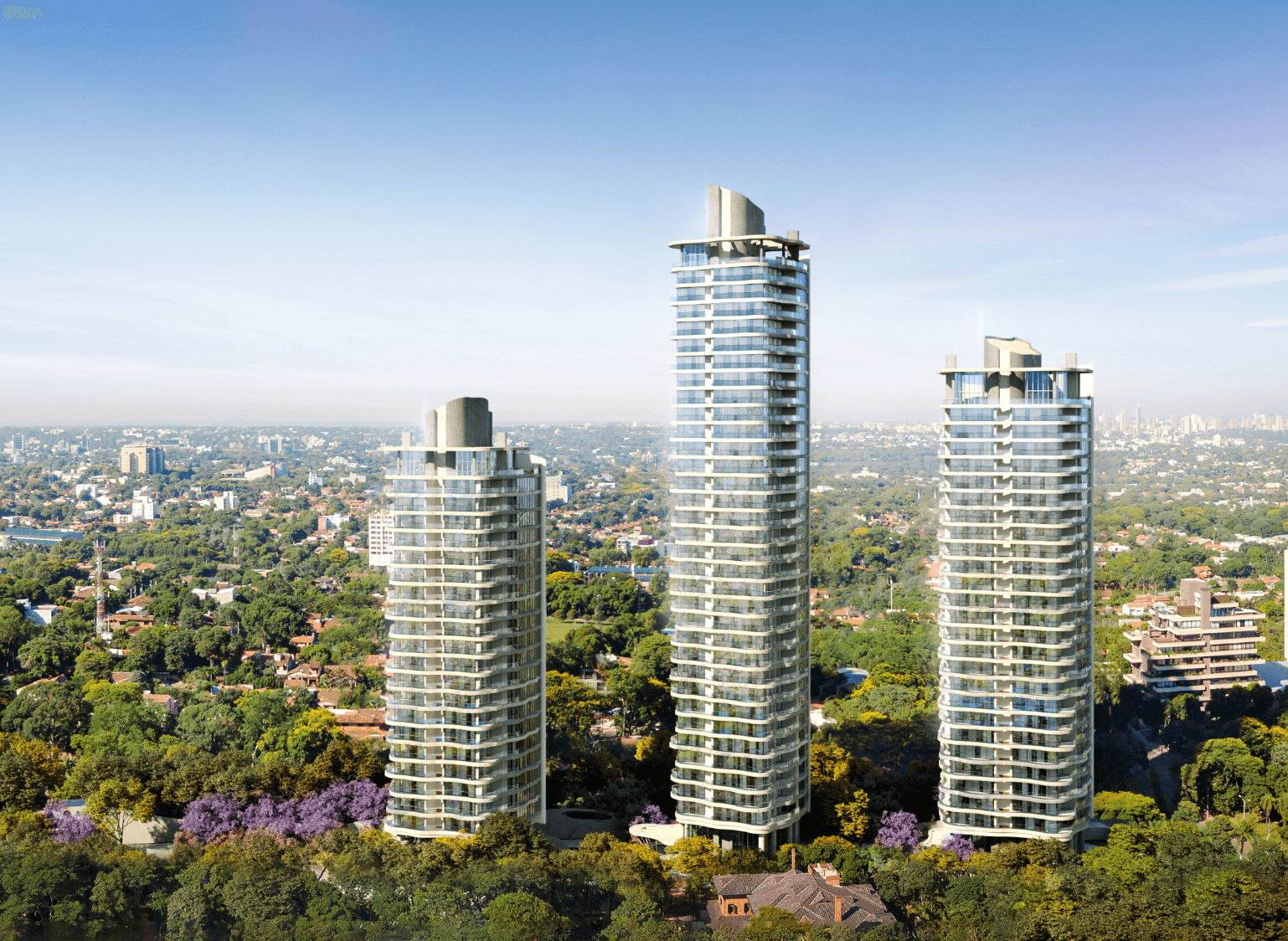
    Asunción remains the primary hub, offering luxury apartments in residential and corporate districts with panoramic views, green surroundings, and premium amenities like those in Jade Park (2-4 bedroom towers), Eminent (Armani-furnished, European-style units), Carmen Dora (up to 380 sqm), and Casa Vista (up to 500 sqm lockable apartments).

    JADE PA

    Popular neighborhoods for modern residences include Ycua Satí, Santo Domingo, San Jorge, Manorá, Las Lomas, and Mburukuya, where properties in the $500,000–$1,000,000 range are highly sought after for their contemporary designs and spacious patios.

    Gated communities are rapidly gaining favor among expats and locals alike, providing enhanced security, superior infrastructure, artificial lagoons, outdoor gyms, event halls, restaurants, and an exclusive lifestyle with shared maintenance costs.

    Beyond Asunción, emerging luxury options exist in Alto Paraná (e.g., Parana Country Club and Costa del Lago in Ciudad del Este/Hernandarias), Encarnación (boosted by tourism, investments, and Argentine migration), and Santa Rita (agri-focused with high per capita GDP).

    New infrastructure, like the Heroes del Chaco bridge, is spurring development in areas such as Nueva Asunción, promising schools, shopping centers, and future growth.

    Foreign buyers benefit from no major restrictions on property acquisition, strong legal security (bolstered by recent registry improvements), fiscal stability, low taxes (e.g., 10% corporate income tax and VAT), and a high quality of life at reasonable costs compared to neighboring countries.

    The market shows a supply gap in the $500,000–$1,000,000 modern residence segment, creating opportunities for appreciation and investment in undervalued luxury properties. Paraguay attracts foreigners with its dynamic economy, investment-grade status, affordable luxury options, and potential for long-term profitability through capital gains and rental yields.

    Overall, the sector positions Paraguay as an increasingly attractive destination for expats establishing residency, offering exclusivity, security, and promising future growth in both urban and regional luxury segments.